A Father and Son’s Healing Journey Through Wounded Warrior Project

The phone rang late in the night at Bob Seifert’s home in Minnesota. A trauma surgeon at a hospital in Virginia was on the other end of the call. His son Garrett was in an accident. Due to Bob’s background in trauma medicine from serving in the Army and National Guard for 26 years, he knew that his son was in trouble based on the injuries the surgeon described.
Bob took the first available flight out of Minnesota to be with his son, not knowing if Garrett would survive the night.
Redefining Life After the Accident
“I don’t remember much of anything,” said warrior Garrett Seifert. “I went to a movie with a friend; I was going to work on my sister’s car.”
Garrett’s father Bob says his son has retrograde amnesia from a traumatic brain injury (TBI), among other injuries, after being struck by a car in Virginia. Garrett served in the Army’s 2nd Ranger Battalion and flew to Virginia to visit family while living in Washington state. He doesn’t recall flying east to be with family, let alone being hit by a car.
“That night, there’s almost no memory from it, I don’t even remember a few months before it,” said Garrett. Bob still has vivid memories of seeing his son in the intensive care unit (ICU) the morning after the accident.

“They had just put a pressure probe in his skull; it didn’t look great for surviving brain tissue. I didn’t think he was going to make it through the night, but he kept hanging in there,” Bob said.
The TBI was just the beginning of Garrett’s injuries.
“He had pneumonia pretty much continuously for the first five months he was in the hospital, the pneumonia almost killed him, he had clots in his legs and ended up with a double pulmonary embolism and went into right-sided heart failure,” recalled Bob. “He was close to dying four to five times and pulled through all of them.”
Bob sat by his son’s side in the ICU in Virginia for three-and-a-half months until Garrett was stable enough to transfer to a Minnesota VA hospital. Bob and his wife, Susanne, alternated staying there with their son for another six-and-a-half months.
“The doctors told my parents that I’d never walk again, and I thought what’s the point of living if I can’t walk or do anything,” said Garrett. “At that point, I thought God must have a plan for me if I’m still sitting here.”
A Family Built on Service

“As far back as I can remember as a kid, being in the military was everything I wanted to do,” said Bob, who retired in 2010 as a master sergeant after a 26-year career. “To be able to join the Army and then actually do all of the things in the Army that I did was everything I dreamed about as a kid.”
“Growing up, all I wanted to do was do what my dad did,” said Garrett, who went to basic training six weeks after graduating high school. “It was a fast track to basic training, airborne school, and Ranger selection. After six months, I was deployed and working with the Afghan National Army.”
Service showed itself in different forms for the Seifert family. Bob wore the uniform and was an example for his children — the youngest of whom is now active duty — but after Garrett’s injury, service for Bob changed to caring for his son.

Bob and Garrett are nearly always together. After Garrett came home from 10 months in hospitals, Bob continued spending his weeks at therapy sessions with him. Defying a prognosis that he would never walk again, Garrett progressed over two years from a wheelchair to a walker and became active in Wounded Warrior Project® (WWP) programs.
“Recovery is going easier and easier, especially with Wounded Warrior Project,” said Garrett. “Every single time I come to a Wounded Warrior Project event, there’s a big change in my ability.”
In February 2025, Garrett participated in Project Odyssey®, an adventure-based mental health program that helped him push beyond what he thought were his limits.
“After the accident and prior to Project Odyssey, I couldn’t use my left hand for almost anything,” recalled Garrett. “But we did a rock-climbing activity where I pushed myself to try to use my hand and when I was done, I was able to grasp and let go of my walker with my left hand. That was a big improvement for me because usually I would have to use my right hand to peel my left hand off the walker handle.”
Garrett’s journey is echoed by many other warriors. According to WWP’s Warrior Survey*, 83% of warriors who participated in WWP programs reported that their quality of life improved because of WWP.
The father-son duo initially participated in WWP events with Bob registered as a family support member. After seeing Garrett enjoy the programs, Bob registered as a warrior, too.
Wounded Warrior Project® (WWP) helps warriors, families, and caregivers plan for the warrior’s long-term care needs, find new purpose, and stay connected to their communities. Learn more about the ways WWP supports warriors like Garrett.
Garrett’s Growth and Recovery Through WWP
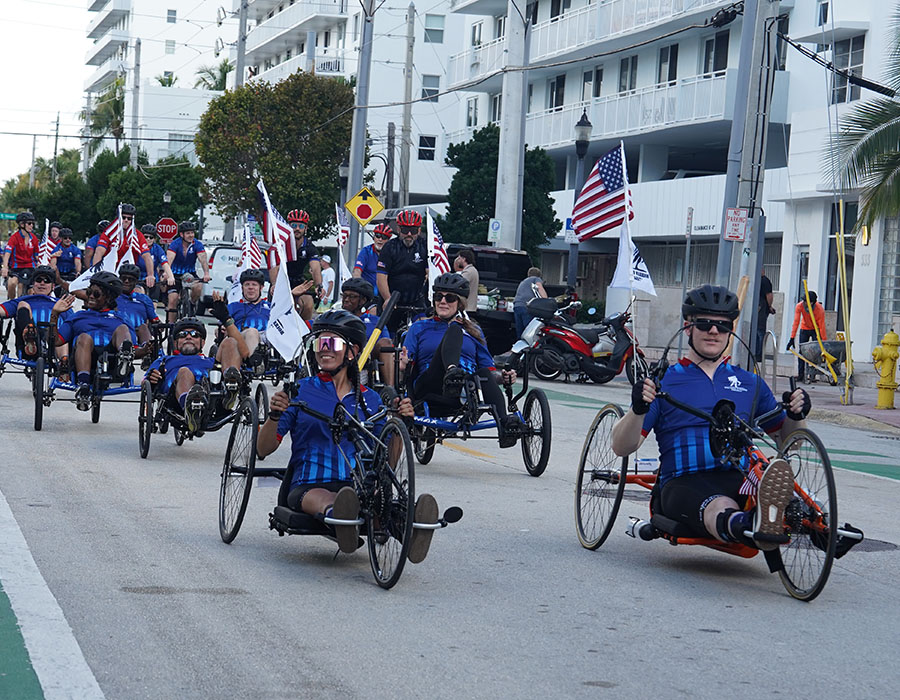
Both Garrett and Bob continued to push each other past what they thought were their limits by participating in different WWP events. They jumped at the chance to challenge themselves by participating in Soldier Ride 250, a 1,000-mile bike ride up the east coast featuring 80 warriors to celebrate America’s 250th Anniversary. As Garrett continues his recovery, he and his dad rode their 250-mile segment from Norfolk, Virginia to Washington, DC, on a tandem recumbent bike, just like they did during their first Soldier Ride® in Minnesota the previous year.
“I hadn’t been on a bike in over 15 years before doing the event last year,” Bob recalled. “I love the ability to be able to spend time with my son.”
Once again, Bob stayed by his son’s side to help.
“I’ve noticed my leg strength is getting better throughout the four days of riding on Soldier Ride 250,” said Garrett. “I’m able to walk without my knee locking whenever I step down. I never expected a bike ride to lead to me getting better at walking, but it’s a welcome improvement.”
While Garrett was struck by his physical improvements, Bob noticed the benefits to his son’s emotional and mental health during Soldier Ride.
“The biggest thing for Garrett is being able to be around other warriors and being able to talk to them and find out that everybody’s going through some sort of struggle. He loves coming to these events,” said Bob.
Garrett’s connection with fellow warriors reflects the powerful bonds many find through shared experience. According to the Warrior Survey, about 2 in 3 WWP warriors (67%) say that talking to another veteran helps them cope with stress or mental health concerns.
The bonds between a father and son were always tight. There’s now a new layer of Bob and Garrett Seifert’s relationship: warriors.
*Warrior Survey, Wave 3 (conducted May 25 – Aug. 1, 2023)
Contact: Rich Donnelly, Public Relations, rdonnelly@woundedwarriorproject.org, 904.831.7315
About Wounded Warrior Project
Wounded Warrior Project® (WWP) is the nation’s leading veterans service organization, focused on the total well-being of veterans, service members, and their families. Our programs, advocacy, and awareness efforts help warriors thrive, provide essential lifelines to families and caregivers, and prevent veteran suicides. Learn more about Wounded Warrior Project.

The journey of 1,000 miles begins with a single pedal. As the United States approaches its 250th anniversary, Wounded Warrior Project® (WWP) is marking the milestone with initiatives that honor...

After being injured in Iraq and medically evacuated, Army veteran Deron Santiny found it hard to open up, even to those closest to him. “It’s not that you don’t want to tell people what you...
U.S. Army veteran Alana Conley read the opening lines of a handwritten letter and felt her voice catch. She paused and took a breath. “The first sentence got me,” Alana said, wiping away...

“We ride. We heal.” Nora and David Butler participating in Soldier Ride Chicago It’s a motto for warriors who participate in the Wounded Warrior Project® (WWP) adaptive cycling event,...